
Tiger Safaris in Kanha
The Complete Guide to the Jungle That Inspired The Jungle Book
Kanha Tiger Reserve · Madhya Pradesh, India
There is a particular quality to the light in Kanha in the early morning. It falls through the sal forest in long, angled shafts, catches the dew on the open meadows, and illuminates a landscape so perfectly composed between wildness and beauty that it feels, in the most literal sense, like a place that could only exist in a story. Rudyard Kipling never visited Kanha — the biographical record is clear on this — yet the park’s meadows, its wolves, its deer, and its tigers so closely match the world of Mowgli that the connection feels inevitable rather than coincidental. The Jungle Book was drawn from the forests of the Seoni and Balaghat districts, and Kanha sits at their heart.
What Kanha offers the modern safari traveller goes considerably beyond literary association. It is one of the largest, most biodiverse, and most professionally managed tiger reserves in India. Its grassland meadows — called maidans — are unique in central India, a habitat type that supports wildlife not found in equivalent density anywhere else in the country. Its tiger population is healthy, growing, and distributed across a landscape large enough to feel genuinely wild even when other vehicles are present. And its infrastructure, accumulated over decades of responsible wildlife tourism, means the experience of a Kanha safari is seamless in a way that newer or less developed reserves cannot quite match.
This is the complete guide to planning your tiger safari in Kanha — zones, vehicles, timing, booking, wildlife, getting there, what to pack, and the deeper story of what makes this forest one of the great wildlife destinations on earth.
Why Kanha Is In a Class of Its Own
Kanha Tiger Reserve covers approximately 2,051 square kilometres of core area — one of the largest protected core zones of any tiger reserve in India — with a surrounding buffer that brings the total protected landscape to around 2,600 square kilometres. This scale matters. Large protected areas sustain larger tiger populations, allow more natural territorial behaviour, and create the conditions for a functioning, self-regulating ecosystem rather than a managed enclosure.
The park was established as a national park in 1955 and became one of the original nine reserves under Project Tiger in 1973. It has been continuously managed for wildlife protection for longer than almost any comparable area in India, and the accumulated institutional knowledge — of the forest, of individual animals, of seasonal patterns — is extraordinary. The naturalists and forest guards who work in Kanha often represent the second or third generation of their family in wildlife conservation. This depth of knowledge permeates every aspect of the safari experience.
The landscape itself is the other defining characteristic. Kanha sits in the Maikal range of the Satpura hills and encompasses a remarkable variety of habitat types: dense sal and mixed forest on the hills, bamboo thickets in the valleys, riverine forest along the Halon and Banjar rivers, and the open meadows — the maidans — that give Kanha its distinctive character. These meadows, created and maintained over centuries by the grazing of large herbivores, are the park’s ecological signature. The Kanha Meadow, the Sondar Tank area, and the Bishanpura Maidan are among the most beautiful and wildlife-rich open habitats in the Indian subcontinent.
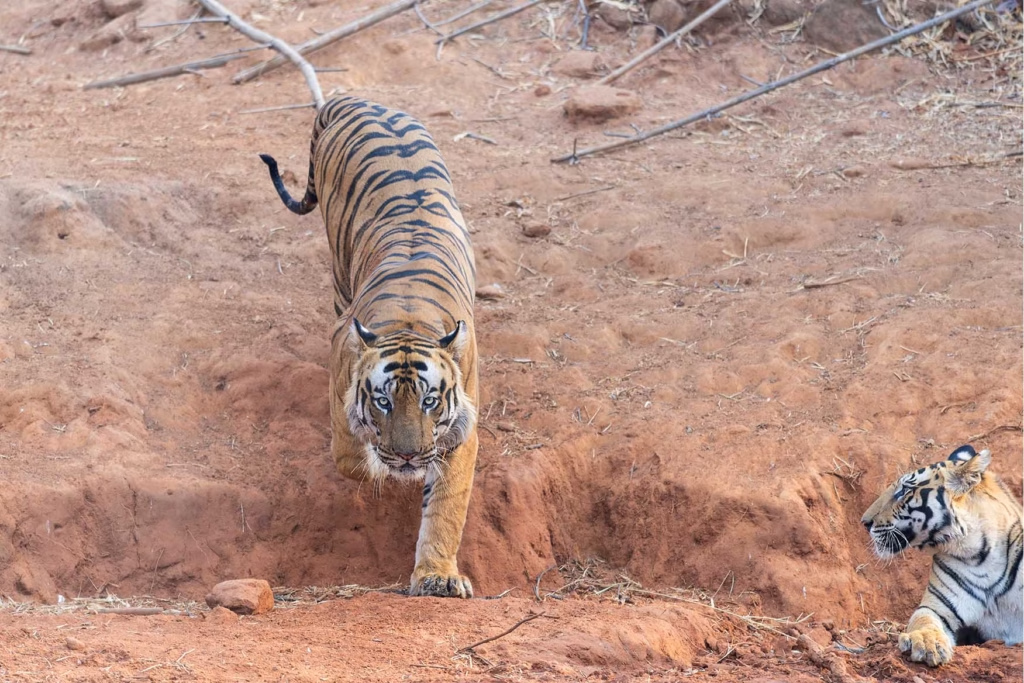
The tiger population is estimated at around 100 individuals across the full reserve, with significant numbers in both the Kanha and Mukki ranges of the core area. Sighting rates are high, particularly in the dry season, and the combination of open meadow habitat and experienced naturalists gives Kanha some of the most extended and behaviorally rich tiger encounters available anywhere.
The Safari Zones and Entry Gates
Kanha is divided into two main ranges within the core area, each accessed from a separate gate, plus a buffer zone with its own entry points. Understanding this geography before you arrive shapes your entire experience.
Kanha Range — Khatia Gate is the more famous and heavily visited section of the park. The Kanha Meadow, one of the most iconic wildlife landscapes in India, is the centrepiece of this range — a vast, open grassland surrounded by forest, where tigresses with cubs have been documented for decades, where barasingha graze in large herds, and where the morning light produces photographic conditions of extraordinary quality. The Kanha Range has the higher concentration of international visitors and the most developed safari infrastructure. Tiger sightings here are excellent, particularly around the meadow edges and the Sondar Tank waterhole area. For first-time visitors to Kanha, the Khatia gate and the Kanha Range is the natural starting point.
Mukki Range — Mukki Gate is accessed from the southern side of the reserve and covers a different and equally compelling section of the park. The terrain in Mukki includes more varied forest, additional open meadows including the Bishanpura Maidan, and riverine habitat along the Banjar River. The tiger population here is strong and in recent seasons Mukki has produced some of the reserve’s most celebrated sightings. The atmosphere at Mukki is slightly less crowded than Khatia, giving safaris a quieter quality that many experienced wildlife visitors prefer. The naturalists of Mukki know their section of forest with the same deep familiarity that Khatia guides bring to the northern range. For multi-day visitors, combining Khatia and Mukki safaris across your stay is the best way to experience the full breadth of Kanha’s landscape.
Sarhi Gate provides an alternative entry into the Kanha Range from the east and is used by properties and visitors approaching from that direction. The safari experience is equivalent to Khatia in terms of wildlife access.
Buffer Zone — Kanha’s buffer zone is extensive and encompasses forest on all sides of the core. The buffer produces tiger sightings with meaningful regularity, particularly as the tiger population has grown and individuals have expanded into buffer territories. Buffer zone safaris are less expensive, face less permit competition, and offer a wilder experience with fewer vehicles. For visitors staying several days, a buffer zone session alongside core zone safaris provides both contrast and additional sighting opportunities.
The practical recommendation is to allocate your first safari to the Kanha Range from Khatia gate, add a Mukki Range session for contrast and complementary wildlife, and consider a buffer zone outing if your schedule allows. For visitors with the luxury of four or more days, splitting time equally between Khatia and Mukki gives the most comprehensive experience of this large and varied reserve.
Safari Vehicles
Kanha operates the familiar two-vehicle system that characterises tiger reserve safaris across Madhya Pradesh and Maharashtra.
The Gypsy, a six-seater open-top 4×4, is the vehicle for serious wildlife watching and photography. In Kanha specifically, the Gypsy’s advantages are particularly pronounced because of the meadow habitat. Open meadow sightings — a tigress crossing the Kanha Meadow at dawn, a tiger and tigress in courtship display in the Bishanpura clearing — require the ability to position the vehicle carefully, to edge forward slowly without disturbing the animal, and to wait in silence for behaviour to unfold. A Gypsy with a skilled driver and naturalist can manage all of this with minimal disturbance. The open sides allow photography in any direction without obstruction.
The Canter carries up to 20 passengers and is the budget alternative. It accesses the same zones and the same meadows, and tiger sightings from Canters are common in Kanha’s open habitat. For budget travellers, families, or large groups, the Canter is a genuine option rather than a significant compromise.
Morning safaris depart at sunrise, approximately 5:30 to 6:30 AM depending on the season. The earliest starts are in the hottest months when the pre-dawn coolness is precious and animals are most active in the brief window before the heat builds. Evening safaris depart between 2:30 and 3:30 PM. Both sessions run for approximately three hours.
Morning safaris are preferred by most serious wildlife enthusiasts for the combination of animal activity, cool temperatures, and beautiful early light. Evening safaris in Kanha have their own rewards — the golden afternoon light on the meadow grass, the return of animals to waterholes as the day cools, and the theatrical quality of a tiger walking through tall grass in a warm, orange light — and should not be undervalued. Doing both sessions on each full day maximises time inside the park and captures the full rhythm of the forest’s daily cycle.
The Best Time to Visit Kanha
Kanha follows the seasonal cycle of the central Indian deciduous forest, with the park closing for the monsoon and reopening in October. The experience varies dramatically across the season, and the best time to visit depends on what you are optimising for.
October and November are the reopening months. The monsoon has ended, the forest is green and lush, and the maidans are full of fresh grass. Wildlife is present and active, and the atmosphere is beautiful — Kanha in October has a quality of freshness and renewal that the dry season months cannot offer. Tiger sightings are somewhat lower as the dense post-monsoon vegetation provides cover, but this is far from a barren period. Migratory birds are arriving, the light is soft and clear, and the park is pleasingly uncrowded. For those who find the dry season crowds and heat unappealing, the October and November window is a genuinely attractive alternative.
December through February is peak season. The vegetation has thinned, temperatures are cool and comfortable — sometimes cold at dawn, with January mornings in Kanha approaching freezing — and wildlife activity is strong across the reserve. Tiger sightings are good in both ranges, the grasslands support large concentrations of grazing animals, and the birdlife reaches its annual peak as winter migrants are fully present. The Christmas and New Year period is the busiest of the year, with both domestic and international visitor numbers at their highest. Permits for prime sessions fill quickly and should be booked months in advance.
March through May is the dry season and the period of maximum tiger sighting probability. As the meadows dry, the waterholes shrink, and the forest opens up as trees drop their leaves, the conditions for observing tigers in the open become optimal. The Kanha Meadow in April — the grass pale gold and short, the forest edge stark and clear, a tigress walking the boundary between open and cover in the early morning — is one of the defining wildlife sights of India. Sighting rates peak in April and early May before the arrival of the pre-monsoon heat makes conditions increasingly challenging.
May is hot. Temperatures in the Kanha valley regularly reach 42 to 45°C, and the heat builds from mid-morning onwards into something genuinely punishing. Morning safaris remain comfortable and often spectacularly productive. Afternoon sessions require heat tolerance. For photographers and serious wildlife enthusiasts, May’s conditions — extreme heat concentrating tigers around permanent water — produce encounters of extraordinary intimacy and duration. For general visitors, late March and April offer the optimal balance of heat tolerance and sighting probability.
June is the final month before the monsoon closure. The park typically closes in late June or early July. Heat is extreme and building towards the breaking of the monsoon, but sighting rates remain high. A small number of dedicated visitors use June specifically for the quality of encounters it offers.
The considered recommendation is that April is Kanha’s finest month for the serious wildlife traveller. March is excellent and more comfortable. December through February offers the best experience for those prioritising comfort and a rounded wildlife holiday. October and November reward those who want solitude, green landscapes, and a less competitive permit environment.
How to Book Safari Permits
Kanha safari permits are managed through the Madhya Pradesh Forest Department’s online booking portal, the same system used for Bandhavgarh and other MP reserves. The portal requires registration and the submission of photo ID details for every passenger at the time of booking.
Permits are released on a rolling basis, with availability opening approximately 90 to 120 days ahead for the forthcoming season and on a continuous rolling basis thereafter. For the Kanha Range from Khatia gate, morning sessions between December and April are the most contested. Permits for prime slots sell out quickly — sometimes within hours of release — and the practical advice is identical to that for other top Indian reserves: register in advance, know exactly which gate, date, and session you want, and book the moment availability opens.
The Mukki Range is slightly less competed for than Khatia but remains popular in peak season. Buffer zone permits face significantly less competition and are available much closer to the date.
Wildlife lodges near both the Khatia and Mukki gates typically hold permit allocations as part of their operating agreements with the Forest Department. Booking safaris through a lodge removes the stress of the online system and ensures that experienced naturalists are arranging your sessions with current knowledge of animal locations and activity. For first-time visitors in particular, this approach is strongly recommended.
A licensed naturalist guide is mandatory and assigned to every vehicle. The naturalists of Kanha — particularly those based at the Khatia and Mukki gates with long experience in their specific range — are among the best in India. A good Kanha naturalist knows the individual tigers of their range personally, understands their territories, their current reproductive status, the location of their kills, and the trees where their alarm systems — the deer and the langur — most reliably signal presence. This knowledge, accumulated across seasons and years, is the difference between a safari that delivers sightings and one that delivers understanding.
Every passenger requires a valid photo ID at the park gate — passport for foreign nationals, Aadhaar or equivalent for Indian nationals. Children below five years of age are generally not permitted inside the core zone. Canteen and toilet facilities are not available inside the core park; carry everything you need for the three-hour session.
The Barasingha: Kanha’s Most Extraordinary Conservation Story
No account of Kanha is complete without addressing its most remarkable wildlife conservation achievement, one that predates the global conservation movement’s current sophistication by several decades and remains a landmark in Indian natural history.
The Swamp Deer, known in Hindi as Barasingha — the twelve-tined antlered deer — is an animal found nowhere else on earth in the hard-ground subspecies that Kanha protects. By the late 1960s, the Kanha population of this subspecies had been reduced to fewer than 70 individuals. The causes were a combination of habitat degradation, hunting, and competition with domestic livestock. The species faced local extinction, and with it the extinction of the entire hard-ground subspecies.
A sustained conservation programme, combining habitat management, strict protection, and the careful relocation of villages from within the park, reversed the trajectory. The meadows were managed specifically to support barasingha grazing requirements. Predation pressure was monitored. The population recovered, slowly at first, then with increasing momentum.
Today, Kanha supports a barasingha population of over 700 individuals. The large herds that graze the Kanha Meadow — dozens of stags with their extraordinary spreading antlers moving through the gold-green grass in the morning light — are the visible evidence of one of India’s most successful wildlife recoveries. Seeing barasingha in the Kanha Meadow is not incidental to a tiger safari here. It is central to understanding what this park is, what it has achieved, and why it matters.
Wildlife Beyond the Tiger
Kanha’s full wildlife community is exceptional and the reserve’s biodiversity rewards careful attention across every safari.
Leopard are present throughout the reserve and sightings, while less predictable than tigers, occur with genuine regularity. The forest edges, rocky hillsides, and riverine areas are the most productive zones. Leopards in Kanha are typically more secretive than the tigers but an early morning encounter — a leopard moving through the sal forest at the edge of a meadow — is a genuinely thrilling sighting.
Wild Dog, or Dhole, are one of Kanha’s great wildlife assets. The reserve has a healthy dhole population and sightings are comparatively common by Indian standards. A pack of dholes on a hunt through the forest or around the meadow edges is one of the most electrifying wildlife encounters the Indian jungle can produce. They are fast, extraordinarily cooperative, and relentless. Even a brief sighting of a pack moving through the forest demands that everything else stops.
Sloth Bear are present and seen with reasonable regularity, particularly in the forest areas away from the meadows. Wild Boar are common throughout. Gaur, the Indian bison, form impressive herds in Kanha’s forest and are regularly encountered on safari. Sambar, the largest Indian deer, are found throughout the reserve and are the tiger’s primary prey species in the forest zones. Chital, the spotted deer, are abundant and their alarm calls — a sharp, insistent bark — are one of the primary ways naturalists locate tigers.
Indian Wolf are present in the buffer zones and the Kanha landscape is among the few places in India where wolf packs still hunt across open grassland in something approaching natural conditions. This connects directly to the Jungle Book narrative — the wolves of Seoni were Kipling’s wolves, and they were the wolves of this landscape.
The birdlife in Kanha is outstanding in quality and variety. The Indian Roller is everywhere and endlessly photogenic. Crested Hawk-Eagle, Changeable Hawk-Eagle, and Crested Serpent Eagle are regularly seen. The Malabar Pied Hornbill is conspicuous in the forest. Indian Pitta, one of the most beautiful birds in Asia, is present during the breeding season. Painted Stork, Black-necked Stork, and various kingfisher species frequent the waterbodies and riverine habitat. Over 300 bird species have been recorded.
The Barasingha, as already noted, are essential. The Kanha Meadow herd in the early morning — sometimes a hundred animals moving together across the open grassland as tiger alarm calls echo from the forest edge — is one of those sights that impresses itself on memory permanently.
Getting to Kanha
Kanha is located in the Mandla and Balaghat districts of Madhya Pradesh and requires a degree of travel planning to reach, though the connections are well established and the journey itself passes through attractive central Indian countryside.
The most practical air gateway for most visitors is Jabalpur Airport, which has direct flights from Delhi, Mumbai, and several other major cities. Jabalpur is approximately 160 to 175 kilometres from Khatia gate — around three to three and a half hours by road. Taxis and pre-booked lodge transfers are readily available.
Nagpur Airport is an alternative gateway, particularly for visitors combining Kanha with Tadoba in Maharashtra. From Nagpur, the drive to Kanha is approximately 270 kilometres, taking around five hours. The road passes through attractive Vidarbha and Madhya Pradesh forest country.
Jabalpur Junction is the nearest major railway station, with good rail connections from Delhi, Mumbai, Kolkata, Chennai, and other cities. The Jabalpur to Khatia road journey takes three to four hours depending on traffic and conditions.
Raipur in Chhattisgarh is another option for visitors approaching from the east, approximately 200 kilometres from Mukki gate — about four hours by road.
For visitors combining Kanha with Bandhavgarh, the two reserves are approximately 280 kilometres apart — around five to six hours by road — making a combined circuit entirely feasible for travellers with a week or more. This combination, Kanha and Bandhavgarh, is widely considered the premier Madhya Pradesh tiger safari circuit and gives a comprehensive picture of the state’s exceptional wildlife heritage.
What to Pack
Neutral earth-toned clothing — khaki, olive, dark tan, forest green. Open safari vehicles in Kanha pass through a variety of habitats including open meadows where visibility is complete. Muted colours reduce visual disturbance and are considered courteous to both wildlife and other visitors.
Warm layers for the December to February season. Kanha mornings in January are cold — genuinely cold, with temperatures approaching 3 to 5°C at dawn — and the wind chill in an open moving vehicle amplifies this considerably. A down jacket or heavy fleece and a light windproof outer layer are sensible rather than excessive. The temperature rises quickly once the sun is up, so layering that can be removed as the morning progresses is practical.
Sun protection for the dry season — high-factor sunscreen applied before departure, a wide-brimmed hat, quality UV-protective sunglasses, and a light long-sleeved shirt. The open meadow habitat in Kanha offers no shade whatsoever, and the April and May sun at altitude in central India is formidable.
Binoculars of 8×42 or 10×42. In Kanha’s meadow terrain, binoculars are perhaps more valuable than in any other Indian tiger reserve. Scanning the far edge of the Kanha Meadow, watching distant barasingha for signs of alarm, reading the body language of a tigress half-hidden in grass three hundred metres away — none of this is possible without optics.
A camera with a telephoto lens, ideally 400mm or more with image stabilisation. In Kanha’s open meadow conditions, distances to tigers can be considerable before the vehicle positions for a closer approach, and longer focal lengths are frequently useful. A second body with a wider lens for landscape and context shots is worthwhile — the Kanha Meadow at dawn is one of the most photogenic natural landscapes in India.
Dust protection for all camera equipment. The dry season tracks generate fine dust that penetrates everything. Sealed bags and lens pouches are essential.
Adequate water — three to four litres for a morning session in the hot season. Kanha’s heat builds quickly after sunrise in April and May and dehydration is a genuine risk if you are unprepared. Light snacks for longer sessions.
Your government-issued photo ID or passport, without exception.
Conservation: Kanha’s Role in India’s Tiger Recovery
Kanha has been at the centre of India’s tiger conservation effort since the beginning of modern wildlife protection in the country, and its contribution extends beyond the protection of its own population to the foundational models and practices that have shaped Indian wildlife management broadly.
Project Tiger, launched in 1973 with nine original reserves, used Kanha as one of its flagship sites partly because the park already had a functioning management infrastructure and a resident scientific community. The research conducted in Kanha in the 1970s and 1980s — on tiger behaviour, home range, prey-predator dynamics, and the ecological role of large carnivores — formed the evidential basis for Project Tiger’s expansion and for India’s subsequent approach to large mammal conservation.
The barasingha recovery programme, described earlier, demonstrated that intensive habitat management combined with strict protection could reverse the trajectory of a species approaching extinction. This lesson has been applied repeatedly across Indian conservation, and Kanha’s success with the barasingha stands as a proof of concept that influenced conservation thinking internationally.
The park’s approach to village relocation — moving communities from within the core zone to allow natural recovery of habitat — has been both effective and, in some cases, contested. The villages of Kanha Meadow were relocated in the 1970s to create the open grassland that is now the park’s most iconic feature. Later relocations have involved more complex negotiations between the Forest Department, communities, and civil society organisations. The ethical dimensions of these processes are real and deserve acknowledgement alongside the conservation outcomes they produce.
Today, Kanha is a source population — its growing tiger population produces surplus animals that disperse into the buffer, into wildlife corridors, and occasionally into adjacent forest landscapes. The health of Kanha’s tiger population has measurable effects on tiger numbers in a much larger surrounding landscape, and the reserve’s protection is an investment with returns that extend far beyond its formal boundaries.
Responsible safari behaviour in Kanha — following all protocols, choosing ethical operators, supporting the local naturalist and wildlife economy — is participation in this broader system. It is a small thing individually and a significant thing collectively.
Planning Your Visit: A Summary
Kanha rewards visitors who approach it with preparation, patience, and a genuine openness to everything the forest offers beyond the tiger.
Book permits for the Kanha Range from Khatia gate and the Mukki Range as far in advance as possible, particularly for March through May sessions when competition is highest. Plan for a minimum of four to six safari sessions across your stay — morning and evening sessions on two or three consecutive days — to experience the full range of what Kanha’s different zones, habitats, and times of day can produce.
Spend time on the Kanha Meadow regardless of whether a tiger appears there on your visit. The meadow at dawn — the barasingha grazing, the rollers calling from the forest edge, the light building across the grass — is extraordinary in its own right and connects you to the landscape in a way that the interior forest tracks, for all their excitement, cannot quite replicate.
Give the naturalist your trust. The best Kanha naturalists carry decades of intimate knowledge of this forest, and the safari experience they can produce — reading the forest, anticipating animal movement, placing the vehicle in the right position at the right moment — is a form of expertise as refined as any professional skill. Ask questions, listen carefully, and allow the safari to be led by knowledge rather than by your own expectations of what a wildlife experience should look like.
Kanha is a large, layered, ancient place. A tiger sighting here is magnificent. But Kanha at its deepest is something more than that — it is a functioning, recovering, genuinely wild ecosystem in one of the most densely populated countries on earth, maintained against considerable odds by the sustained effort of generations of conservationists, naturalists, and local communities. To walk away from it understanding that, as well as having seen a tiger, is to have received the full value of what it offers.
Keywords: Kanha tiger safari, Kanha National Park, Kanha Tiger Reserve, tiger safari Madhya Pradesh, Kanha safari zones, Khatia gate Kanha, Mukki gate Kanha, best time to visit Kanha, barasingha Kanha, Jungle Book wildlife India, Bengal tiger sighting central India, Kanha safari booking