
Satpura Tiger Safaris: India’s Most Extraordinary Wilderness Experience
The complete guide to luxury tiger safaris in Satpura Tiger Reserve, Madhya Pradesh. Walking safaris, canoe trips, jeep game drives, top lodges, best time to visit, and why Satpura is India’s most immersive wildlife destination.
Every serious wildlife traveller in India eventually hears the same advice from naturalists who have worked across the subcontinent’s great reserves: if you want the tiger experience that most resembles what this landscape once was — unhurried, multi-dimensional, genuinely wild — go to Satpura. Not instead of Kanha or Bandhavgarh or Ranthambore, but in addition to them, and ideally last, so that what you find there reframes everything that came before.
Satpura Tiger Reserve in Madhya Pradesh is the park that rewards the traveller who has stopped chasing and started watching. It is the reserve where a walking safari at dawn, a canoe trip down a forest river at dusk, and a night in a lodge that feels genuinely embedded in the wild combine into something that no jeep-only park can replicate. It is, by a meaningful margin, India’s most immersive wildlife destination — and among its most beautiful.
SATPURA: THE RESERVE THAT DOES THINGS DIFFERENTLY
Satpura Tiger Reserve sits in the Hoshangabad district of Madhya Pradesh, in the ancient Satpura hill range that gives the reserve its name. The total protected area encompasses over 2,130 square kilometres when core zone, buffer zone, and the adjoining Bori and Pachmarhi sanctuaries are taken together — making it one of the largest contiguous protected landscapes in Central India.
The core zone of Satpura National Park covers approximately 524 square kilometres and is the heart of the safari experience. This is not flat, open grassland terrain. Satpura is dramatically topographic — a landscape of sandstone gorges, forested plateaux, rocky ridgelines, river valleys, and dense teak and sal forest broken by open meadows and seasonal streams. The Denwa River forms the northern boundary of the core zone, and the Tawa Reservoir, one of the largest in Madhya Pradesh, defines the eastern edge. Water, forest, and rock in extraordinary combination.
What makes Satpura structurally different from every other major tiger reserve in India is what you are permitted to do inside it. While most Indian national parks restrict visitors to motorised jeep safaris on designated tracks, Satpura offers walking safaris on foot with armed forest guards and naturalists, canoe safaris on the Denwa River, boat trips on the Tawa Reservoir, and night game drives in the buffer zone. This multi-modal approach to wildlife exploration transforms the experience from passive observation into genuine engagement with the landscape at every scale.
THE WILDLIFE OF SATPURA TIGER RESERVE
Satpura’s ecological profile reflects its position at the meeting point of several distinct habitat types — the Satpura hills, the Vindhyan escarpment, and the Deccan plateau — which together produce an unusually rich and varied fauna.
The Bengal tiger is the apex predator and primary draw, though Satpura’s tigers are notably more elusive than those in heavily touristed parks like Kanha or Bandhavgarh. The terrain works against easy sightings — this is not open grassland country where a tiger crossing three hundred metres away is immediately visible. In Satpura, tigers move through dense forest, along rocky ridgelines, and in the deep shadow of sandstone gorges. When a sighting does occur, often at close range on a walking trail or at a forest waterhole, it has an intensity and unexpectedness that no open-country encounter can match. Satpura is the park where you earn your tiger — and where, when it appears, it feels genuinely wild rather than performed.
The leopard is seen with good frequency in Satpura, particularly in the rocky terrain of the plateau areas. Indian wild dog (dhole) packs are encountered on jeep tracks and forest roads. Sloth bears are regularly seen in the buffer zone and on rocky outcrops within the core zone — Satpura has one of the healthier sloth bear populations in Central India, and dawn game drives in the buffer zone offer particularly reliable sightings.
The Indian gaur moves through Satpura’s forests in impressive herds. Sambar, chital, nilgai, and wild boar are numerous throughout the reserve and form the prey base that supports the predator population. The Indian giant squirrel — a spectacular, rust-and-cream coloured arboreal mammal — is commonly seen in the forest canopy and is one of Satpura’s particular wildlife signatures. Smooth-coated otters inhabit the Denwa River and are encountered with delightful regularity on canoe safaris, surfacing and diving around the boat in a manner that suggests genuine curiosity. Mugger crocodiles bask on the Denwa’s sandy banks and on the reservoir’s margins.
The birdlife of Satpura is outstanding and diverse. Over 300 species have been recorded, including the Malabar pied hornbill, crested serpent eagle, changeable hawk-eagle, Indian skimmer on the river, various kingfishers, and a particularly rich suite of forest owls and nightjars that make the night game drives remarkable even when larger mammals are not immediately forthcoming. The Indian pitta, one of the jewels of the subcontinent’s avifauna, is a forest floor resident during the monsoon.
WHAT MAKES SATPURA TRULY UNIQUE: THE SAFARI FORMATS
The diversity of safari formats available at Satpura is the reserve’s defining characteristic and the primary reason why a Satpura visit occupies a different category from any other Indian wildlife destination.
Walking Safaris
Walking safaris in Satpura — conducted with an armed forest guard, a lead naturalist, and a maximum of six guests — are the most singular experience available in Indian wildlife tourism. There is no equivalent at any other major Indian tiger reserve. On foot in the forest, the entire quality of attention shifts. You hear things you would miss in a jeep: the alarm call of a sambar fifty metres away in the teak, the distant contact call of a tiger, the sudden silence of a forest that has detected something moving. Your naturalist reads pugmarks in the trail dust, identifies scratch marks on a tree bole, points to where a gaur herd has bedded in the shade of a ravine.
The pace of a walking safari is slow and deliberate, punctuated by stops to examine signs, watch birds, or simply stand still and listen. The forest, approached this way, reveals a density of information that a moving vehicle never can. Even a walk that produces no large mammal sightings is richly rewarding — the smaller details of the ecosystem open up in a way that permanently changes how you see a forest.
When a walking safari does produce a large mammal encounter — a sloth bear shuffling across the trail, a gaur herd stopping to assess the human figures standing quietly at the forest edge, or the electrifying, close-range materialisation of a tiger — the experience is unforgettable in a way that is qualitatively different from anything that happens in a vehicle. You are in the jungle, not driving through it.
Walking safaris must be booked in advance through your lodge and are subject to weather and forest department approval. Early morning is the standard timing. Physical fitness is required — walks cover between three and eight kilometres over varied terrain including rocky hillsides and river crossings. Closed shoes with ankle support, long trousers, and earth-toned clothing are essential.
Canoe Safaris on the Denwa River
The Denwa River canoe safari is one of the finest wildlife experiences in India. In narrow, traditional canoes paddled by expert local boatmen, guests move silently downstream through the forest boundary, watching the riverbanks for the full suite of Satpura’s riverine wildlife — mugger crocodiles on sandy banks, smooth-coated otters hunting in the shallows, Indian skimmers skimming the water’s surface with geometric precision, kingfishers flashing electric blue between the overhanging branches, and — with genuine frequency — leopards, sloth bears, and occasionally tigers coming to the river to drink at dawn or dusk.
The silence of the canoe is everything. Wildlife at the waterline that would flush immediately at a jeep engine will hold its position as a paddled canoe drifts past at walking pace. Mugger crocodiles that might slide into the water at the sound of a motor will continue basking as the canoe passes five metres away. The approach fundamentally changes the encounter.
Canoe safaris are typically conducted in the late afternoon and early evening, ending on the river as the light fades and the forest fills with the sounds of the night shift beginning. They are subject to river level and weather conditions and should be booked as a priority — slots are limited and the experience is one of the highlights of any Satpura visit.
Jeep Safaris
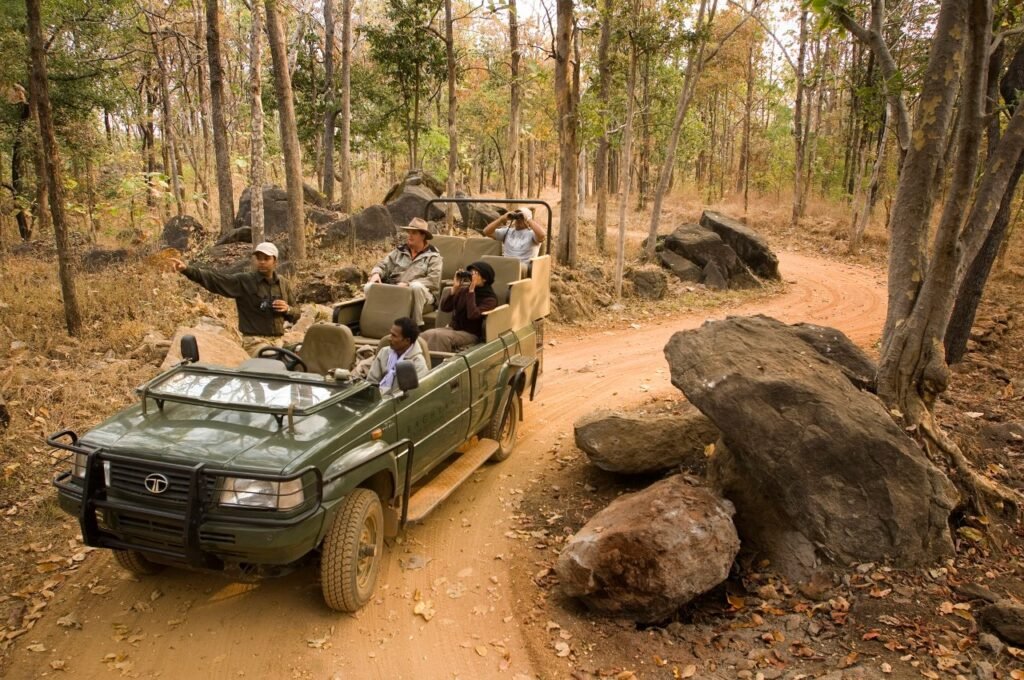
Standard four-wheel-drive jeep safaris operate in both the core zone and the buffer zone twice daily, following the morning and evening patterns of most Indian parks. Core zone safaris penetrate the finest tiger habitat and offer the best chance of large mammal encounters. Buffer zone jeep safaris — particularly dawn drives — are excellent for sloth bear, leopard, and birds, with significantly less vehicle pressure than the core zone.
Satpura’s core zone jeep tracks wind through genuinely beautiful terrain — along forest ridgelines with views across the Denwa valley, down into sandstone gorges where the light filters green through the sal canopy, past ancient rock shelters and seasonal pools that mark ancient wildlife crossings. Even without a tiger sighting, a core zone jeep safari in Satpura is a landscape experience of the highest order.
Private jeep safaris with a dedicated naturalist, arranged through premium lodges, are strongly recommended over shared vehicles. The ability to stop, wait, and reposition without the pressure of a shared group’s expectations is the difference between a good safari and an exceptional one.
Night Game Drives
Night game drives in the buffer zone are permitted at Satpura in a way that they are not in most Indian core national park areas. After dark, the cast of characters changes entirely. Porcupines trundle across the track. Civets move along fallen logs. Nightjars sit on the warm laterite road, their eyeshine red in the spotlight. Leopards are encountered with good frequency on nocturnal drives, and the calls of forest owls — brown fish owl, mottled wood owl, jungle owlet — create an acoustic atmosphere that is completely distinct from the daytime forest.
For naturalists and wildlife photographers, the night drive adds an entire ecological chapter to the Satpura story. Combined with a dawn walking safari the following morning, it creates a nearly continuous twenty-four-hour engagement with the reserve’s wildlife that no single-format park can offer.
Boat Safaris on the Tawa Reservoir
The Tawa Reservoir, adjacent to the eastern buffer zone, supports a distinct aquatic ecosystem and is excellent for waterbirds, raptors, smooth-coated otters, and mugger crocodiles. Boat trips in the early morning across the reservoir’s calm surface, with the forested hills of the buffer zone reflected in the water and osprey hunting overhead, provide a meditative counterpoint to the more active forest safaris. This is also one of the best vantage points for watching the Satpura landscape at a distance — the scale of the forested hills, undisturbed to every horizon, is a reminder of what this reserve actually is.
LUXURY ACCOMMODATION IN SATPURA
Satpura has cultivated one of the most refined luxury lodge ecosystems of any Indian wildlife reserve, with properties that match the park’s distinctive character — intimate, immersive, genuinely connected to the wild — rather than simply transplanting a resort aesthetic into a forest setting.
Forsyth Lodge
Named after Captain James Forsyth, the nineteenth-century British officer who wrote The Highlands of Central India and first brought the Satpura hills to wider attention, Forsyth Lodge is among the finest wildlife lodges in India and one of the finest in Asia. Situated on the banks of the Denwa River with the Satpura hills forming the horizon on every side, the lodge combines deep local expertise with exceptional food, beautiful cottage design, and a safari programme that is widely regarded as the gold standard for Satpura.
The naturalists at Forsyth have an intimate knowledge of the reserve built over years of daily engagement with its wildlife. The lodge manages its own canoe safari programme, conducts walking safaris with highly experienced guides, and coordinates all safari formats into a coherent, carefully paced itinerary that gives guests time to absorb as well as observe. The food — regional Madhya Pradesh cuisine alongside international options, all sourced locally where possible — is outstanding. The lodge accommodates a small number of guests, giving it an atmosphere of genuine exclusivity without pretension.
Reni Pani Jungle Lodge
Reni Pani is a Taj Safaris property and one of the flagship luxury wildlife lodges in India. Twelve beautifully designed tented cottages are set within a sal forest clearing on the Denwa riverbank, each with a private deck and uninterrupted forest views. The lodge’s design aesthetic is confident and refined — natural materials, high ceilings, the sound of the river always present. Service matches the best Indian luxury hospitality, and the safari programme is managed by experienced resident naturalists with strong forest department relationships.
Reni Pani is the choice for travellers who want the full luxury lodge experience — spa treatments, exceptional dining, immaculate service — combined with a serious wildlife programme. It works particularly well for couples who may have different levels of wildlife enthusiasm, since the lodge’s non-safari hours are as well-curated as the game drives themselves.
Denwa Backwater Escape
A smaller, more boutique property on the Tawa Reservoir backwaters, Denwa Backwater Escape offers a quieter, more intimate alternative to the larger lodges. The setting — cottages overlooking the reservoir with the forested hills of the buffer zone on the far bank — is extraordinarily beautiful, particularly at dawn and dusk. The lodge operates a full safari programme including walking, canoeing, and jeep drives, with a resident naturalist whose knowledge of the reservoir’s birdlife is particularly strong.
This property is especially recommended for birdwatchers and photographers who want a serene base with exceptional light on the water at both ends of the day.
Churna Island Camp
A more rustic, adventurous option, Churna Island Camp occupies a small island in the Tawa Reservoir accessible only by boat. The camp’s isolation is its primary appeal — you are genuinely inside the landscape rather than adjacent to it. Accommodation is comfortable rather than luxurious, but the experience of waking on an island surrounded by reservoir and forested hills, with otters hunting from the shore and fish eagles overhead, is something that a more manicured lodge cannot replicate.
THE BEST TIME TO VISIT SATPURA
Satpura follows the seasonal rhythms of Central India but with some important nuances owing to its topography and the multi-format safari programme.
October to February is the most comfortable season and the finest for walking safaris. Post-monsoon vegetation is lush and the forest is at its most beautiful, the canopy green and full. Temperatures are mild to cool — daytime highs in December and January reach 20 to 25°C, with cold mornings requiring an additional layer on early walks and canoe trips. Tiger sightings are possible throughout but the dense vegetation can reduce sight lines in the core zone. The birdlife in this period is exceptional, with winter migrants swelling the resident species list significantly.
March to May is the prime season for large mammal sightings and the most strategically productive time for the serious wildlife traveller. As vegetation dries and the forest management burns reduce the grass cover, sight lines open dramatically and animals concentrate near the remaining water sources along the Denwa River and at core zone waterholes. Tiger sightings increase significantly from March onwards. The canoe safari becomes even more productive as wildlife pressure on the river intensifies with rising temperatures. By April and May the heat is considerable — daytime temperatures reach 40°C or more — but morning safaris from 5:30 AM and evening canoe trips from 4:00 PM avoid the worst of the heat, and the wildlife activity in those windows is at its peak.
The park closes during the monsoon months, typically from June 15 to October 15, though exact dates vary by year and forest department decision.
GETTING TO SATPURA
The nearest airport is at Bhopal, approximately 165 kilometres from the park, served by regular flights from Delhi, Mumbai, Hyderabad, and other major Indian cities. The drive from Bhopal takes approximately three to four hours through the Madhya Pradesh countryside and is manageable in a comfortable vehicle.
Pipariya is the nearest railway station at approximately 50 kilometres from the reserve, connected to the main Delhi–Mumbai railway line and offering reasonable connectivity from major cities. Most premium lodges arrange pickup from both Bhopal airport and Pipariya station as a standard part of their service. The nearest town is Hoshangabad, approximately 40 kilometres away, with Pachmarhi hill station — a worthwhile addition to any Satpura itinerary — accessible within a couple of hours.
A SUGGESTED LUXURY SATPURA ITINERARY
A five to seven night stay at Satpura, based at Forsyth Lodge or Reni Pani, allows thorough exploration of all safari formats without rushing.
The first morning opens with an elephant-back excursion or a dawn jeep drive into the buffer zone — easing into the reserve’s rhythms before the more demanding walks begin. The first full day pairs a core zone jeep safari in the morning with an afternoon canoe trip on the Denwa — an immediate immersion in both the forest and the river dimensions of the reserve. The second and third days introduce walking safaris at dawn, with afternoon jeep drives into different sectors of the core zone. A night game drive in the buffer zone adds the nocturnal chapter. The fourth day is given to the Tawa Reservoir — a boat safari at dawn followed by a relaxed morning at the lodge, allowing time for the landscape to settle rather than perpetually pursuing the next sighting. Final days return to the core zone for further walking and jeep exploration, and a last canoe trip at golden hour closes the journey on the water.
This structure — layering formats rather than repeating them — is the way to truly know Satpura rather than simply visit it.
SATPURA AND THE WIDER LANDSCAPE
Satpura does not exist in ecological isolation. The reserve forms part of a larger Central Indian tiger landscape that includes Kanha, Pench, and Bori-Pachmarhi, connected by forest corridors through which tigers and other wide-ranging species move. Conservation efforts to maintain and restore these corridors are among the most significant landscape-scale wildlife initiatives in Asia and represent the long-term future of tiger viability in this region.
The Pachmarhi hill station, declared a UNESCO Biosphere Reserve, sits within the wider Satpura landscape and is worth adding to any itinerary for its extraordinary rock art — ancient cave paintings at Bhimbetka and within the Pachmarhi hills — its waterfalls, and its own suite of forest wildlife. The combination of Satpura safari and Pachmarhi exploration makes for a complete Central Indian journey that encompasses both the wild and the deep human history embedded in this ancient landscape.
WHY SATPURA BELONGS ON EVERY SERIOUS WILDLIFE TRAVELLER’S LIST
Satpura does not promise the easiest tiger sighting in India. Kanha has more open terrain. Bandhavgarh has higher tiger density in a more accessible landscape. Ranthambore has the fortress and the mythology. Satpura offers something none of them can: the complete wild experience, approached on foot, on water, in a canoe, and on a jeep, in a landscape of such beauty and ecological depth that the tiger, when it comes — and it will come — feels not like a trophy collected but like a genuine encounter with something ancient and free.
That is a rare thing anywhere on earth. In India, it is available at Satpura, and nowhere else quite like it.
Satpura rewards the traveller who arrives without a checklist. Walk slowly. Paddle quietly. Listen before you look. The forest will show you everything — on its own terms, in its own time.