
Kabini: The Complete Guide to Southern India’s Most Magical Wildlife Destination
There is a moment that happens at Kabini, usually at dusk, that people who have witnessed it struggle to describe without reaching for language they would normally consider excessive. The Kabini reservoir backwaters catch the last light of the day in a particular way — copper and amber spreading across still water — and in that light, on most evenings, elephants are drinking. Sometimes dozens of them. Sometimes a hundred. The herd moves into the shallows, the calves swim between the adults, the light fails slowly, and the forest behind them darkens into silence. It is, by any measure, one of the great wildlife spectacles on earth.
Kabini is the name given to the southern section of Nagarhole National Park, one of the core areas of the Nilgiri Biosphere Reserve — the largest protected forest in peninsular India, encompassing Nagarhole, Bandipur, Mudumalai, and Wayanad in an interlocking network of protected land that stretches across Karnataka, Tamil Nadu, and Kerala. The Kabini River, dammed in 1974 to create a reservoir, forms the southern boundary of Nagarhole and the northern boundary of Bandipur, creating a wildlife corridor of exceptional importance and a water body that draws wildlife from both reserves in concentrations that have made this one of the most reliably productive wildlife watching destinations in Asia.
Unlike the central Indian reserves — Kanha, Bandhavgarh, Tadoba — Kabini operates somewhat differently in character and atmosphere. The forest is denser, the vegetation more tropical, the landscape greener and more layered than the dry deciduous forests of Madhya Pradesh. The wildlife community is different too: the Asiatic Elephant rather than the tiger is the dominant spectacle, wild dog sightings are exceptional, and the range of species on offer in a single safari session can be staggering. Tigers are here and seen with increasing frequency as the population grows, but Kabini asks you to broaden your definition of what constitutes an extraordinary wildlife experience. Most visitors who come for the tiger leave having been most moved by something else entirely.
This is the complete guide to planning your wildlife safari at Kabini.
Why Kabini Is Exceptional
The Nilgiri Biosphere Reserve, of which Nagarhole and Kabini form the northern section, covers approximately 5,500 square kilometres of protected forest. This scale matters enormously. Large, connected forest landscapes sustain larger and more genetically diverse populations of every species. Tigers in Kabini are part of a meta-population that moves across Nagarhole, Bandipur, and beyond. Elephants range across the entire biosphere reserve in seasonal movements that cover hundreds of kilometres. The ecological health of this landscape reflects the cumulative protection effort of several decades and multiple state forest departments.
Kabini specifically benefits from the reservoir. The 55-square-kilometre backwater acts as a permanent magnet for wildlife, particularly in the dry season when the surrounding forest becomes drier and animals converge on the water. The open water and the grassland edges along its banks create visibility conditions that the interior forest does not offer — animals that might be invisible in dense vegetation are observable at length near the water. The juxtaposition of open water, grassland fringe, and dark forest creates a visual drama in the evening light that no other wildlife destination in southern India can match.
The atmosphere at Kabini is also distinct from northern and central Indian reserves. The landscape feels more lush, more layered, more tropical. The air is heavier with moisture. The bird calls are different — the forest is full of sounds that are distinctly southern and different from the sal forests of Uttarakhand or the teak forests of Maharashtra. And the infrastructure of wildlife tourism here, built around a small number of high-quality lodges on the reservoir bank, creates an immersive experience in which the boundary between your accommodation and the wildlife is genuinely thin. Elephants walk through lodge grounds at night. Dholes have been seen on the lawn. A leopard was once photographed sitting on a lodge roof.
Understanding the Park and Safari Structure
Kabini, as a safari destination, operates through the southern entry gates of Nagarhole National Park. The Karnataka Forest Department manages safari permits and vehicle access, and the system differs in certain respects from the Madhya Pradesh and Maharashtra models.
The core safari area accessible from Kabini covers the southern section of Nagarhole, centred on the reservoir backwaters and the forest immediately behind them. Safaris enter the forest from the Kabini area and travel through a network of tracks covering varied habitats — dense mixed forest, bamboo groves, grassland clearings, teak woodland, and the riverine vegetation along the reservoir edges.
Government Jeep Safaris are operated by the Forest Department from the Kabini entry point. These run in the morning and evening sessions, typically carrying six passengers in an open Gypsy-type vehicle, with a Forest Department guide. The government safari system is the most affordable option and produces excellent wildlife sightings. Permits are bookable through the Karnataka Forest Department’s online portal in advance.
Private Lodge Safaris — the high-end lodges at Kabini, most notably the Orange County Kabini and the Evolve Back Kabini (formerly Orange County), as well as Bison Resort and others, operate their own safari vehicles with experienced naturalists for their resident guests. These private safaris often enter the forest earlier than the government vehicles, cover slightly different routes, and benefit from the deep local knowledge of lodge naturalists who have spent years in this specific landscape. The lodge safari experience is more intimate, better guided, and — for guests who can afford the lodge rates — worth the significant price premium.
Boat Safaris on the Kabini reservoir are among the most distinctive wildlife experiences available anywhere in India. Open motorised boats carry small groups of passengers along the reservoir backwaters in the early morning and evening. The perspective from water is completely different from a vehicle — you approach animals from the waterside, you observe the reservoir ecosystem directly, and the vantage point for elephant herds drinking and bathing is extraordinary. Boat safaris also produce excellent sightings of crocodile, waterbirds, otters, and occasionally tigers drinking at the water’s edge. A boat safari combined with a jeep safari on the same day gives a comprehensive picture of Kabini’s wildlife in its full habitat range.
The permits system requires advance planning. Government safari permits sell out quickly for peak season and weekend dates. Private lodge guests have guaranteed access through their property’s allocation. For independent visitors using government safaris, booking several weeks to a couple of months ahead is recommended for prime dates.
The Safari Zones and Key Areas
Unlike the numbered zone systems of many central Indian reserves, Kabini’s safari area is a single large territory accessed from the reservoir bank. Within this territory, certain areas have developed reputations for specific wildlife experiences.
The reservoir backwaters and grassland fringe are the heart of the Kabini experience. The open water draws elephants, gaur, spotted deer, and occasional tigers to drink in conditions of full visibility. The grassland edges, particularly in the late afternoon and evening, see the most concentrated animal activity of the day as the heat breaks and animals emerge from the forest interior. This is where the famous Kabini elephant gatherings occur — herds of 50, 100, or occasionally more animals converging on the water in the evening light.
The mixed forest interior of Nagarhole behind the reservoir is where most tiger sightings occur. The forest here is a combination of teak, rosewood, silver oak, and bamboo, denser and more varied than the dry forests of central India. Tigers move through this terrain using the tracks and forest edges, and sightings — while less frequent per safari session than at Bandhavgarh or Tadoba — are genuine and growing as the Kabini tiger population expands. The naturalists who know this forest track individual tigers by pugmarks, camera trap data, and long experience, and their ability to anticipate where to look significantly improves sighting rates.
The bamboo zones in the interior are productive for elephant sightings and for the forest wildlife that uses dense cover — leopard, sloth bear, and smaller mammals. Bamboo forest in Nagarhole has a quality of light and texture unlike anything in the drier reserves and is beautiful in its own right.
The Nagarhole riverine areas along the Kabini River and its tributaries support distinct bird and reptile communities and are worth specific attention for birdwatchers and naturalists interested in the full range of the ecosystem.
Wildlife: The Full Spectacular Cast
Kabini’s wildlife community is one of the most diverse and abundant of any reserve in India, and the full cast of species available in a single visit is extraordinary.
Tiger — The Kabini tiger population has grown steadily over the past decade as Project Tiger’s protections have taken effect across the Nilgiri Biosphere Reserve. Sighting rates are lower than at the top central Indian parks — a reflection of the denser vegetation and larger home ranges characteristic of this forest type — but are improving year on year. Camera trap surveys have documented significant numbers of tigers in the Nagarhole landscape and individual animals are increasingly habituated to vehicle presence. A tiger sighting at Kabini, when it comes, often involves an animal moving through forest that feels genuinely wild in a way that is different from the open-country sightings of Ranthambore or Bandhavgarh.
Asian Elephant — Without question the defining wildlife spectacle of Kabini. Nagarhole and the broader Nilgiri landscape support one of the largest Asian elephant populations in the world — estimates for the entire Nilgiri Biosphere Reserve place the number at several thousand individuals. At Kabini specifically, the reservoir draws elephants throughout the day and in extraordinary concentrations in the evening. Families, bachelor herds, and solitary bulls all use the water. Calves swim in the shallows. Adults drink, mud-bathe, and engage in the complex social behaviours that make elephant watching endlessly absorbing. A Kabini evening boat safari during the dry season, with a hundred elephants at the waterside in failing light, is an experience that cannot be replicated anywhere else.
Wild Dog (Dhole) — Kabini is among the finest places in India to observe dhole, and sightings here are more reliable than at almost any other reserve. The dhole packs of Nagarhole are well studied and some individuals are habituated to vehicles. A pack of fifteen to twenty dholes moving through the forest at dawn, or assembled near a kill, is one of the most viscerally exciting wildlife experiences the Indian jungle offers. The social sophistication of dhole packs — the communication, the cooperative hunting strategy, the care of pups — rewards patient observation beyond the initial excitement of the encounter.
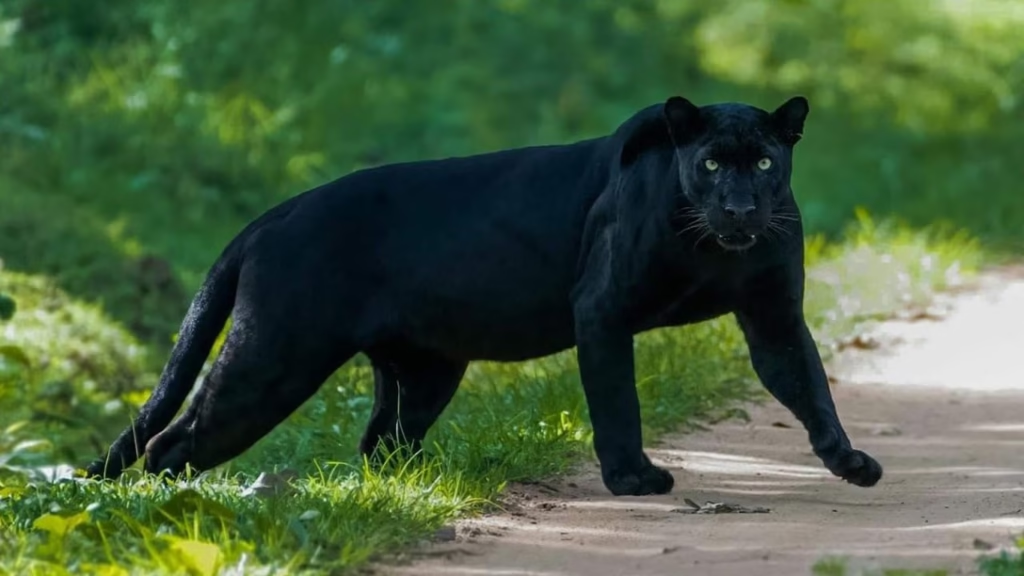
Leopard — Present throughout the reserve and seen with reasonable frequency, particularly in the forest interior and along the edges of cleared areas. Kabini’s leopards are less regularly encountered than its elephants or dholes but appear often enough to be expected rather than hoped for. Tree sightings — a leopard resting in the fork of a rosewood tree — are among the most prized.
Gaur — The Indian bison are abundant in Nagarhole and the herds here are impressive. Groups of gaur emerge from the forest to graze the grassland edges near the reservoir in the early morning and evening, the massive animals moving with a surprising delicacy for their size. Bull gaur at Kabini are enormous — the largest individuals carry a bulk that makes even the biggest sambar look modest.
Sloth Bear — Present and seen with reasonable regularity in the forested areas away from the reservoir. Kabini sloth bear sightings tend to be briefer than in the more open reserves of central India but are satisfying for their relative rarity in the southern context.
Sambar and Chital — Both species are abundant. Sambar, the large dark deer of the forest interior, are particularly common near the reservoir edge and in the bamboo zones. Chital in large herds graze the grassland fringe, their alarm calls providing the forest’s early warning system for predator movements.
Mugger Crocodile — The reservoir supports a substantial mugger population. Large adults bask on the exposed banks and mudflats, particularly in the cooler months, and the boat safari provides close and extended observation of these animals in conditions that a vehicle cannot replicate.
Indian Python, Monitor Lizard, and Cobra — All present and seen with regularity. The riverine and reservoir edges are particularly productive for reptile sightings.
The Birds — Kabini’s birdlife is outstanding in both diversity and spectacle. The forest holds a range of species typical of the Western Ghats transition zone, and the reservoir adds a comprehensive waterbird community. Malabar Pied Hornbill and Great Hornbill are both present and regularly seen. Crested Hawk-Eagle, Changeable Hawk-Eagle, and Crested Serpent Eagle are common raptors. The Lesser Fish Eagle and Grey-headed Fish Eagle work the reservoir. Oriental Darter and various cormorant species fish the backwaters. Painted Stork, Woolly-necked Stork, and Open-billed Stork are present. The Jungle Owlet, Brown Hawk-Owl, and Mottled Wood Owl represent the nocturnal community. Over 270 species have been recorded in the Nagarhole landscape.
The Best Time to Visit Kabini
Kabini’s seasonal calendar differs from the central Indian reserves because the Nilgiri region receives rainfall from both the southwest and northeast monsoons, creating a more complex seasonal pattern.
October through January is the post-southwest monsoon and northeast monsoon period. The forest is green and lush, temperatures are pleasantly cool to warm, and wildlife activity is strong. October and November bring fresh vegetation after the monsoon and the park feels alive with new growth. December and January are particularly pleasant — comfortable temperatures, good wildlife sightings, and the beginning of the dry period that will intensify through spring. The elephant gatherings at the reservoir begin building in this period. This is an excellent time for birdwatching as both resident and migratory species are present.
February through May is the dry season and the period of maximum wildlife viewing quality. As the surrounding forest dries progressively, the Kabini reservoir becomes increasingly important as a water source, and the concentrations of wildlife along its banks build towards a peak in April and May. The elephant gatherings in March, April, and May can be extraordinary — the largest aggregations of Asian elephants routinely observable anywhere in the world. Tiger sighting rates improve as vegetation thins and animals concentrate near water. The dhole packs are highly active. Gaur herds graze the exposed grassland. The visual conditions are excellent. April and May are Kabini at its most spectacular wildlife-wise, though temperatures in May can reach 38 to 40°C. March and April balance heat and spectacle most favourably.
June and July bring the southwest monsoon. Kabini receives significant rainfall and the park partially closes or reduces safari operations during the peak monsoon period. Some lodges close entirely for maintenance and reopening preparation. The forest transforms dramatically — lush, green, rain-soaked — but wildlife viewing is challenging in the dense wet vegetation.
August and September see the tail end of the southwest monsoon. Some operations resume towards the end of September. The landscape is beautiful in this period — intensely green, with waterfalls flowing and the reservoir full — but wildlife is dispersed and sightings are lower.
The recommendation for most visitors is to target February through April for the combination of elephant spectacle, good tiger sighting rates, comfortable temperatures, and the full complement of wildlife activity. December through January is excellent for those who prefer cooler conditions and good all-round wildlife without the heat of the dry season peak.
Getting to Kabini
Kabini is located in the Mysuru district of Karnataka and is well connected to the major cities of southern India.
The nearest city is Mysuru (Mysore), approximately 80 kilometres from Kabini — around two hours by road. Mysuru has good rail and road connections from Bengaluru and is a logical staging point for a Kabini visit. The drive from Mysuru to Kabini passes through sugarcane fields and coffee plantation country before entering the forest fringe, and is pleasant in its own right.
Bengaluru (Bangalore) is the primary air gateway for most international and domestic visitors. Kempegowda International Airport is approximately 220 to 240 kilometres from Kabini — around four to five hours by road. The drive from Bengaluru via Mysuru is the standard approach, with Mysuru often included as an overnight stop to break the journey. Several direct road services and private transfers operate between Bengaluru airport and Kabini lodges.
For visitors combining Kabini with other southern Indian wildlife destinations, the geography is well suited to a circuit. Bandipur National Park — the southern section of the same Nilgiri landscape — is approximately 90 kilometres from Kabini, around two hours by road. Mudumalai Tiger Reserve in Tamil Nadu adjoins Bandipur and is a further extension of the same forest. A circuit covering Kabini, Bandipur, and Mudumalai gives a comprehensive experience of the Nilgiri Biosphere Reserve’s three main tourism access points.
Coorg, the coffee-growing hill district, is approximately 60 kilometres from Kabini and is frequently combined with a Kabini visit as part of a Karnataka hill and wildlife circuit.
Where to Stay: The Kabini Lodge Experience
While accommodation is outside the main scope of this guide, it is impossible to discuss Kabini without acknowledging that the lodge experience here is integral to the wildlife experience in a way that is more pronounced than at most Indian reserves. The lodges at Kabini sit directly on the reservoir bank, and the boundary between lodge grounds and forest is genuinely porous. Elephants walk through at night. Dholes have been observed on lodge lawns. A naturalist evening walk from your accommodation is a wildlife activity in its own right.
The quality of wildlife naturalists attached to the major Kabini lodges is among the highest in India. Several have spent decades in this specific landscape and have a knowledge of individual animals, seasonal patterns, and forest behaviour that is exceptional. The investment in a lodge that employs experienced, dedicated naturalists pays dividends in the depth and quality of every safari session.
What to Pack
Neutral earth-toned clothing — khaki, olive, dark green, grey. Kabini’s forest is denser and more tropical than central Indian reserves, and muted colours are particularly important in this verdant environment where bright colours stand out sharply.
Light layers for early morning game drives in the cooler months — December through February mornings can be cool enough for a light fleece, particularly on the open boat safari where the water amplifies the chill. The rest of the day is warm to hot.
Sun protection for the dry season — high-factor sunscreen, hat, and sunglasses. The boat safari on open water offers no shade and the southern Indian sun is intense.
Insect repellent. The Kabini reservoir environment, particularly in the evenings and early mornings, has a significant mosquito population. A good repellent and light covering clothing for boat safaris and evening game drives are important. Antimalarial precautions should be discussed with a travel medicine professional before visiting any Indian wildlife area, including Kabini.
Binoculars — 8×42 or 10×42. Essential for birdwatching and for observing elephant behaviour across the reservoir at distance.
A camera with a telephoto lens. The boat safari creates unique photographic opportunities for elephant and waterbird shots. A 400mm lens is the starting point for wildlife photography, though the open reservoir conditions mean that longer focal lengths are useful for elephant herds on the far bank. A wide-angle lens for landscape shots — the reservoir in evening light — is also worthwhile.
Waterproof protection for camera equipment on the boat safari — morning mist and occasional spray can affect equipment.
Your government-issued photo ID or passport.
Conservation: The Nilgiri Biosphere and What It Represents
Kabini and Nagarhole sit within a conservation landscape that represents one of the most significant wildlife protection achievements in southern Asia. The Nilgiri Biosphere Reserve, designated in 1986, was India’s first biosphere reserve and encompasses a total area of over 5,500 square kilometres of connected forest across three states. The political and logistical achievement of maintaining this connectivity — of preventing the roads, settlements, and agricultural land that surround the biosphere from fragmenting it into isolated islands — is ongoing and contested.
The elephant population of the Nilgiri landscape is the largest concentration of Asian elephants outside of Sri Lanka and certain areas of northeastern India. The genetic health of this population, its ability to sustain normal social structures and seasonal movements across the landscape, depends directly on the maintenance of forest corridors between the protected areas. Where these corridors are intact, the population is healthy. Where they are disrupted by roads, canals, or settlements, human-elephant conflict intensifies and elephant welfare suffers.
The tiger population of the Nilgiri landscape has grown substantially under Project Tiger’s protection framework. Nagarhole was designated a tiger reserve in 1999 and the subsequent decades have seen consistent population growth as protection improved and prey base recovered. The tigers of Kabini are part of a meta-population that connects, through forest corridors, to tigers in Bandipur, Mudumalai, and further into the Western Ghats.
The indigenous communities of the Nilgiri landscape — the Jenu Kuruba, Betta Kuruba, Soliga, and other tribal groups — have complex, contested, and evolving relationships with the forest and with wildlife conservation policy. Issues of forest rights, access, and relocation echo through the conservation history of this landscape, and honest engagement with Kabini as a destination requires acknowledgement of these dimensions alongside the celebration of the wildlife.
Tourism at Kabini, conducted responsibly and through operators who invest in local communities and naturalist employment, contributes to the economic case for conservation in a landscape that faces significant pressure from agricultural expansion, hydropower development, and infrastructure growth. Your presence here, and the choices you make about how to visit and whom to support, are part of a larger story.
Planning Your Visit: A Summary
Kabini rewards visitors who come without a single fixed expectation and allow the landscape to set the terms of the encounter.
Book in advance — government safari permits and lodge accommodation at Kabini fill quickly for peak season dates, particularly March through May and the December holiday period. If your budget allows a lodge stay on the reservoir bank, prioritise this above almost any other planning decision. The combination of on-site naturalist expertise, boat safari access, and the evening light on the water from your accommodation is the full Kabini experience.
Do the boat safari. This is not optional. The perspective from the water, particularly in the evening during the dry season, is unlike anything a jeep can offer and the elephant gatherings viewed from the reservoir are the image of Kabini that stays with you longest.
Expand your wildlife expectations beyond the tiger. Kabini with abundant elephants, dhole, gaur, leopard, extraordinary birds, and the boat safari experience is already one of the finest wildlife destinations in Asia. A tiger sighting here is a bonus of the highest order — and it may well come — but a Kabini visit without one is not a failure. It is still, by any global measure, an extraordinary experience.
Come in April if you can. The dry season reservoir, the elephant concentrations, the thinning vegetation opening the forest to view, and the quality of light in the late afternoon on the Kabini backwaters — these combine in April into something that people who have experienced it return to, repeatedly, for the rest of their lives.
Keywords: Kabini wildlife safari, Kabini National Park, Nagarhole tiger reserve, elephant safari Karnataka, Kabini reservoir wildlife, tiger safari southern India, Kabini boat safari, best time to visit Kabini, Nilgiri Biosphere Reserve, dhole sighting India, wild dog safari Karnataka, Kabini safari booking, Karnataka wildlife tourism